What’s Inside a Glowster
A little bit of science, a little bit of engineering, and no batteries.
A Glowster looks pretty simple. And, honestly, it is. That’s part of the point.
There’s no battery, no switch, no electronics and nothing that needs to be plugged in. But inside that little coaster are a few carefully chosen materials doing some surprisingly clever things. A Glowster is made from three basic layers:
A photoluminescent layer + reflective PVC + cork.
The cork gives the Glowster its soft, forgiving base. The PVC provides strength and, importantly, gives the light something to reflect off of. The photoluminescent material is what makes the magic happen.
Four things can happen to light inside a Glowster
The glow-in-the-dark material we use contains strontium aluminate, a modern photoluminescent material that safely stores energy from light and slowly releases it as a visible glow.
When light enters the photoluminescent layer, there are several things that can happen.
1. It can reflect.
Some incoming light doesn't get absorbed at all. It simply bounces off the surface of the material. In other words, we can see it.
2. It can be absorbed.
This is the useful part.
Strontium aluminate absorbs photons from the surrounding light and stores them. That's what allows the Glowster to keep glowing after the lights go out.
3. It can be emitted as visible light.
Over time, those stored photons are released as visible light.
That's the glow you see.
4. It can be emitted towards the cork layer.
Some of that newly released light travels down towards the cork rather than up toward your eyes.
That's where the reflective PVC becomes important.
Instead of letting that light disappear into the bottom of the Glowster, the highly reflective PVC sends much of it back toward the photoluminescent layer.
And now something interesting happens: some of that light can be absorbed again.
So the PVC isn't just there to make the Glowster stronger.
It helps the light-producing material make better use of the light it has.
Why not just use more glow material?
Good question.
We could make a Glowster with a very high concentration of strontium aluminate. With enough of the stuff, a photoluminescent material can be formulated to produce a very long-lasting glow—potentially well beyond 20 hours.
But there's a catch.
It gets expensive.
And more isn't necessarily better.
A Glowster doesn't need to illuminate your bedroom. In fact, that's exactly what we don't want it to do.
The goal is just enough light to let your eyes find the edge of the bed, the leg of a chair, a toy on the floor or the path to the bathroom—without turning on a light and waking yourself up.
So rather than simply loading the Glowster with as much expensive glow material as possible, we use a more modest concentration and make the rest of the system work harder. That's where the reflective PVC earns its keep.
The white layer matters
If you've ever wondered why there's a white layer underneath the glowing material, now you know. It isn't just there because white looks nice, It is highly reflective.
Light that would otherwise travel down into the Glowster can be reflected back toward the photoluminescent material. Some of that light can then be absorbed and eventually emitted again.
Think of it as giving the light another chance.
This combination lets us get useful nighttime performance without having to fill the Glowster with an unnecessarily large amount of expensive photoluminescent material.
Less material. Better use of the material. Lower cost.
That's good engineering.
And then there's the PVC itself
The reflective layer has another job that has nothing to do with light.
It provides structure.
A Glowster may spend its life sitting quietly under a bedpost, chair leg, nightstand or piece of furniture. That means it has to deal with weight—and sometimes quite a lot of it.
The PVC layer helps distribute that load and gives the Glowster the stiffness it needs to function as a coaster and furniture protector.
On most floors and carpets, it can handle the weight of a bedpost without simply disappearing into the carpet.
(We wouldn't recommend putting one under a particularly heavy piece of furniture on a very thick, plush carpet. Even the Sandman has his limits.)
Simple on purpose
So what's inside a Glowster?
Not a battery.
Not a circuit board.
Not a tiny light bulb.
Just a few carefully selected materials working together:
Photoluminescent material to store and release light.
Reflective PVC to send more of that light where it can be useful—and to provide strength.
Cork to provide a soft, non-scratch base.
The result is something deliberately simple.
Charge it with ordinary light. Turn off the lights. And it quietly does its job.
Because when you're walking around the house at 2:00 in the morning, you don't really need a nightlight.
You just need to see where you're going.
— The Sandman
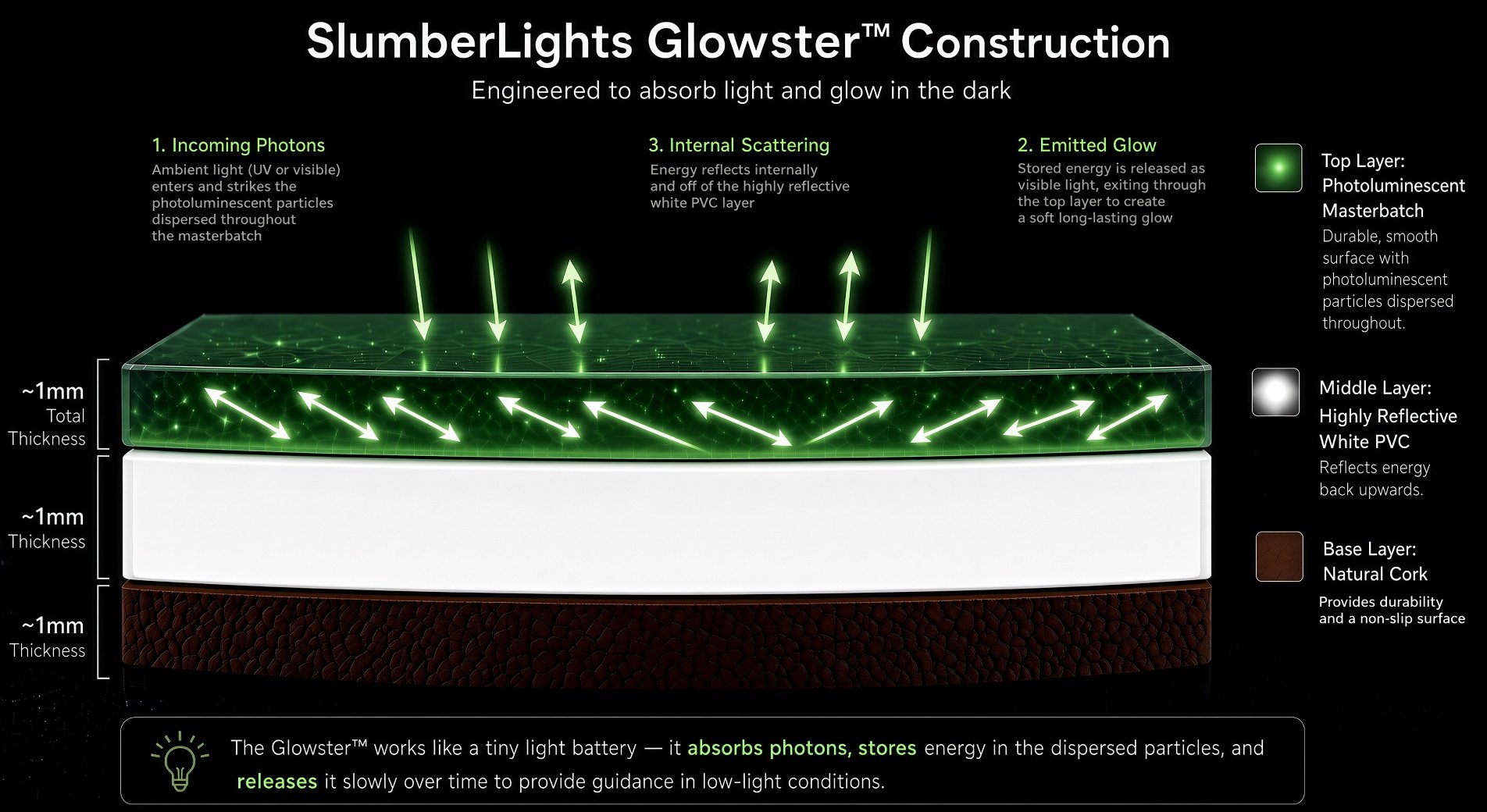
This illustrates how photons move within the Slumberlights Glowster.
